
What Does a Developmental Editor Do for a Fantasy or Sci-Fi Novel?
You’ve finished your draft, but something still feels uncertain. Maybe the pacing drags in the middle? Maybe your worldbuilding is rich, but you are not sure whether it supports the story or overwhelms it? That uncertainty is exactly where developmental editing becomes valuable.
So, what does a developmental editor do?
A developmental editor looks at the big-picture foundations of your manuscript. Instead of focusing on grammar or typos, they assess structure, plot, pacing, character arcs, worldbuilding, thematic cohesion and overall reader experience. For fantasy and sci-fi novels, that also means stress-testing the internal logic of your invented world so the story feels immersive and clear.
If you are comparing editorial support for your manuscript, it helps to start with a clear understanding of what developmental editing services are actually designed to do.
What Does a Developmental Editor Do for Fantasy or Sci-Fi?
Developmental editing is the structural stage of the editorial process. It takes place before copy editing and proofreading, when your manuscript still has room for meaningful revision.
A developmental editor reviews whether your novel works as a story. They look at factors such as whether:
the plot develops logically
the tension builds in the right places
your characters’ decisions feel earned
the manuscript delivers the reading experience you want it to deliver.
For speculative fiction, this work goes even deeper. Fantasy and sci-fi novels often rely on complex systems, unfamiliar settings, layered politics or unusual technologies. A developmental editor helps ensure those elements feel coherent rather than confusing for the reader.
The goal is not simply to tell you what is wrong. It is to help you understand why something is not working and what effect it has on the reader. Plus, a great editor will guide you in understanding how you can strengthen your manuscript without losing sight of your original vision.
In simple terms, a developmental editor helps you see your manuscript as a reader would, while also bringing a professional understanding of story structure and commercial positioning.
Why Fantasy and Sci-Fi Novels Need a Developmental Editor
Speculative fiction has unique structural demands. In theory, you are asking readers to trust worlds that do not exist, so the logic behind those worlds has to feel solid.
Let’s consider an example. If a magic system solves one problem in Chapter 3 but cannot solve a similar problem later without explanation, readers will notice. If a sci-fi society is built around advanced technology but the social or political consequences of that technology never appear on your pages, the world can start to feel poorly designed.
These risks are why specialist developmental editing matters for fantasy and sci-fi. A genre-aware editor is not just looking for general pacing or character issues. They are also asking whether your worldbuilding supports the story and checking if your rules remain consistent.
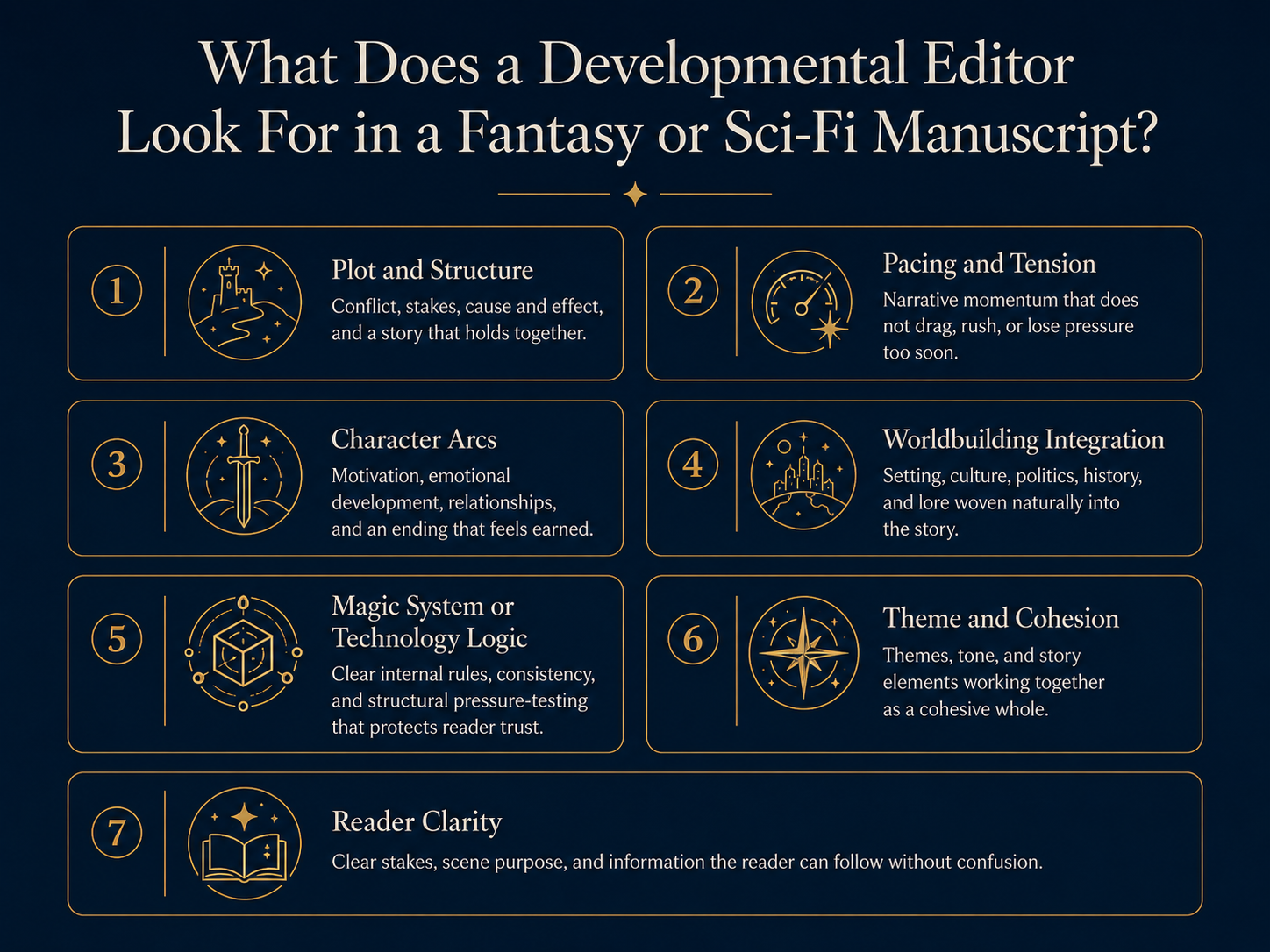
What Does a Developmental Editor Look For in a Fantasy or Sci-Fi Manuscript?
Plot and Structure
Plot and structure refer to the framework of your story: what happens, why it happens and how each event builds on the last. Does the central conflict build properly? Are the stakes clear? Do cause and effect hold together from scene to scene?
A developmental editor will flag plot holes and places where your story loses momentum or wanders away from its core promise.
Pacing and Tension
Pacing is the speed at which the story unfolds, while tension is the sense of pressure or anticipation that keeps readers turning pages. Fantasy and sci-fi often need space for things like atmosphere, politics, culture, lore or technical detail.
The challenge is making sure that depth does not slow the narrative to a crawl. A developmental editor identifies where the manuscript rushes, drags or releases tension too early or late, so your story keeps readers engaged rather than testing their patience.
Character Arcs
A character arc is the internal journey a character goes on throughout your novel. Even the most inventive premise will fall flat if the emotional journey does not land.
A developmental editor looks at motivation, internal conflict, relationships and whether your protagonist’s arc feels earned by the end of the story.
Worldbuilding Integration
Worldbuilding integration is the way your invented setting and its systems are woven into the actual story, rather than sitting beside it as background information. Here’s a good way to look at it: strong worldbuilding should serve your novel, not smother it.
A developmental editor checks whether setting, culture, history, religion, class systems, technology or politics are woven into the story in a way that feels natural and relevant to the central narrative.
Magic System or Technology Logic
Magic systems and technology logic refer to the internal rules governing how magic, science, powers or advanced technology work in your world. In fantasy, this often means testing the boundaries and loopholes of the magic system.
In sci-fi, it can mean considering scientific plausibility and internal consistency. A great editor considers whether your world's rules remain stable throughout the manuscript. This kind of structural pressure-testing is what protects reader trust.
Theme and Cohesion
Theme is the deeper idea or message running through the story. Similarly, cohesion is the sense that all the novel’s elements belong together.
A developmental editor also looks at whether the moving parts of the novel belong together. Do the themes connect with the plot? Does the tone stay consistent? Does the story feel like a cohesive whole rather than a collection of interesting ideas?
Reader Clarity
Reader clarity is about how easily your audience can follow what is happening and, why it matters. Your editor will pinpoint where readers may become confused, or disengaged. Common culprits for this kind of feedback include information dumps, vague stakes, muddled scene purpose and sections where your manuscript assumes too much knowledge too early.
What Problems Can a Developmental Editor Fix?
A developmental editor doesn’t rewrite your novel for you, but they do identify the root causes behind structural problems and show you where to focus your revisions.
For example, they might flag that your opening chapters contain too much worldbuilding before the story has fully started. They may notice that a side character is carrying more emotional weight than the protagonist, or that your ending relies on a solution your magic system has not properly earned.
For fantasy and sci-fi authors, this kind of feedback can be especially valuable because speculative fiction problems often hide inside otherwise exciting ideas.
The issue is rarely that your concept is too ambitious. More often, the structure underneath it needs strengthening so the ambition can actually land on the page.
What a Developmental Editor Doesn’t Do
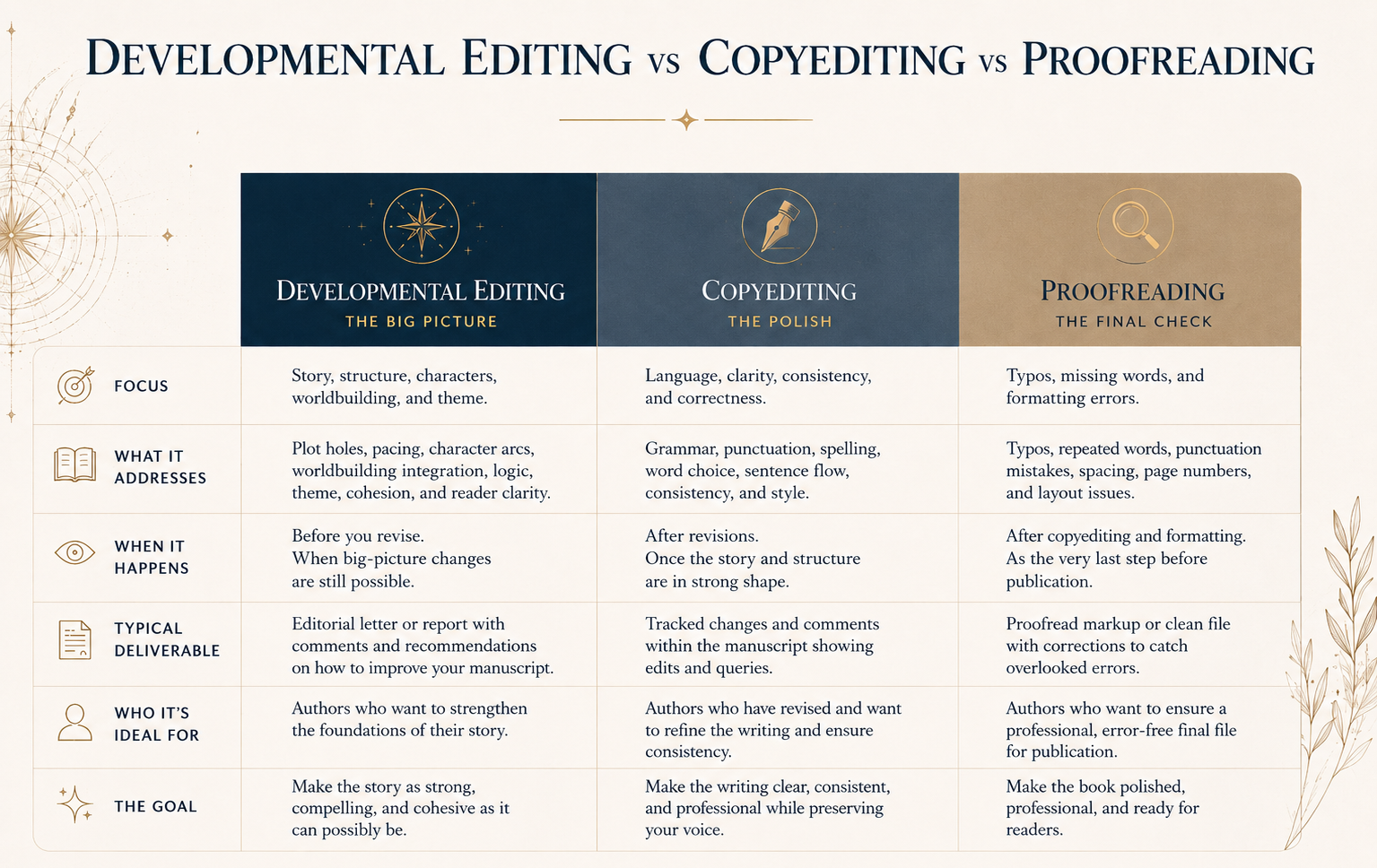
A developmental editor is not the same as a copy editor or proofreader.
Developmental editing focuses on big-picture story issues such as structure, pacing, character development and worldbuilding logic.
Copyediting comes later and deals with sentence-level concerns like grammar, punctuation, syntax and consistency.
Proofreading is the final stage, checking for lingering typos or formatting mistakes once the manuscript is already polished.
This distinction matters because it helps self-publishing authors invest in the right support at the right time. There is little value in polishing sentences that may be cut or moved after a structural edit.
If you are still weighing up the differences, read our guide to developmental editing vs copy-editing vs proofreading.
What Do You Receive From a Developmental Edit?
Every editor works a little differently, but a professional developmental edit should leave you with a clear and actionable roadmap for revision.
Your developmental edit with EV Editing can include:
In-manuscript comments: Detailed comments throughout your manuscript showing exactly where structural issues and revision priorities appear on the page.
A substantial editorial assessment: A comprehensive report breaking down the manuscript’s strengths and weaknesses. The assessment covers big-picture revision requirements.
Guidance on structural priorities: Clear direction on what to fix first, so your revision process feels manageable rather than overwhelming.
A revision review or V2 edit: Follow-up support on your revised manuscript to check whether the key structural issues have been addressed effectively.
A halfway-point update: A progress update during the edit that helps you feel confident in how the process is unfolding.
A post-edit debrief or next-steps call: A conversation about the feedback and the best next steps in your self-publishing journey.
When Should You Hire a Developmental Editor?
A developmental editor should usually come in after you have completed your first draft and done a solid self-edit. It’s important to remember that developmental editing comes before copyediting, proofreading and final formatting.
That order matters. Developmental editing is where you solve the foundational issues first. Once the structure is secure, you can move on to refining the prose and preparing the manuscript for publication.
For self-publishing authors, this stage is often one of the smartest investments in the whole process. It gives you a stronger manuscript before you spend more time and money on later editorial stages.
Is Developmental Editing Worth It for Self-Published Fantasy and Sci-Fi Authors?
If you want to publish a novel that feels immersive and coherent, developmental editing is the most valuable stage on your journey to a professionally polished final product.
Developmental editing helps you improve narrative momentum and resolve the kind of structural weaknesses that can lead to poor reviews or reader disinterest. For speculative fiction in particular, it also gives you the chance to test whether your worldbuilding and magic systems are doing the job you need them to do.
FAQs About Developmental Editing for Fantasy and Sci-Fi
What does a developmental editor do for a fantasy novel?
A developmental editor reviews your story’s structure, pacing, character arcs and worldbuilding. A great editor also checks that your lore and logic remain consistent throughout the manuscript.
What does a developmental editor do for a sci-fi novel?
For a sci-fi novel, a developmental editor looks at the same big-picture storytelling elements. But it also examines how technology, speculative concepts, social structures and internal rules support your narrative.
Can a developmental editor fix plot holes?
A developmental editor can identify plot holes and structural inconsistencies. They don’t rewrite the book for you, but they provide the analysis and guidance needed for you to revise those issues effectively.
Does a developmental editor help with worldbuilding?
Yes. For speculative fiction, worldbuilding is one of the key areas developmental editing can support. A great editor checks whether your world feels consistent and integrated into the story rather than sitting beside it.
Is developmental editing the same as copyediting?
No. Developmental editing focuses on structure and story-level concerns, while copyediting focuses on sentence-level clarity and grammar.
Ready to Strengthen Your Fantasy or Sci-Fi Novel?
A developmental editor helps you strengthen the foundations of your fantasy or sci-fi novel before you move into later editing stages. For speculative fiction authors, that means making sure all the components work together in a way that feels satisfying to your readers.
At EV Editing, developmental editing is built for self-published fantasy and sci-fi authors who want thoughtful, commercially aware support without losing the heart of their story. The focus is always on structural integrity and helping you create a stronger book for the market you want to reach.
If you are preparing your manuscript for publication and want expert feedback on its big-picture structure, browse the FAQs or book a free consultation to discuss your manuscript and next steps.