

Self-Publishing Timeline for Speculative Fiction Authors: When to Expect Editing, Cover Design and Formatting
Wondering when to schedule editing, cover design and formatting for your speculative fiction novel? This guide explains the ideal self-publishing timeline for speculative fiction authors, from developmental editing and revisions to copy-editing, formatting, proofreading and launch preparation.
This article covers:
Why Speculative Fiction Authors Need a Clear Publishing Timeline
The Ideal Self-Publishing Timeline For Speculative Fiction Authors
Phase 1: Finish the Draft and Self-Edit
Phase 2: Developmental Editing
Phase 3: Complete Your Developmental Revisions
Phase 4: Cover Design
Phase 5: Copy-Editing
Phase 6: Final Reviews
Phase 7: Formatting and Typesetting
Phase 8: Proofreading
Phase 9: Launch Preparation
Common Timeline Mistakes Speculative Fiction Authors Should Avoid
How Far in Advance Should You Plan?
FAQs
How EV Editing Supports the Journey
Self-publishing a speculative fiction novel is exciting, but it’s also easy to get the order of things wrong. One of the most common mistakes speculative fiction authors make is confusing the order of self-publishing.
That can lead to rushed decisions and a final book that doesn’t reflect the quality of the story inside. The truth is that successful self-publishing follows a clear production timeline. The earlier you understand that timeline, the smoother the process becomes.
Speculative fiction novels often need even more planning than other fiction genres. For example, complex worldbuilding and invented terminology all add layers that affect editing, design, covers and formatting.
In this guide, I’ll walk you through a practical self-publishing timeline for speculative fiction authors, including the best time for each step, so your novel moves from finished draft to polished product without unnecessary chaos.
Why Speculative Fiction Authors Need a Clear Publishing Timeline
A speculative fiction novel is a complete reader experience. Readers expect immersive worldbuilding and consistent internal logic. You can signal to them that they’ve picked up the right novel through all components: your cover, your interior layout, your blurb and your editorial quality all work together to build trust.
Hence, your publishing timeline matters as much as the final copy. For example, if copy-editing takes place before developmental revisions are complete, you risk paying to polish prose that will later be rewritten. If you proofread before formatting is final, you may miss errors introduced during the layout stage.
Ultimately, a clear and well-planned self-publishing timeline protects your energy and your book’s quality.
The Ideal Self-Publishing Timeline For Speculative Fiction Authors
Every author’s schedule will vary, but a typical timeline after completing the draft often looks something like this.
Phase I: Finish the Draft and Self-Edit
Approximate time: 2–6 weeks
Congratulations on completing your manuscript! Now, the exciting journey to publication begins.
Before professional support steps in, take time to complete a serious self-edit. Don’t worry about obsessively polishing every sentence. At this stage, your goal is to make the manuscript clean enough for a professional to assess the real structural issues.
At this stage, it’s best to focus on:
obvious repetition
continuity slips
clunky exposition
scenes that clearly drag
worldbuilding elements that need clarification
unnecessary word count
For speculative fiction authors, this phase is especially important because inconsistent magic rules and over-explained lore can all make the manuscript harder to assess. A cleaner draft helps your developmental editor focus on the big-picture foundations rather than avoidable surface issues.
Phase II: Developmental Editing
Booking window: Ideally, as soon as your draft is nearly ready
Editing timeframe: Often 6–12 weeks
Developmental editing should be the first professional editing stage in your self-publishing timeline.
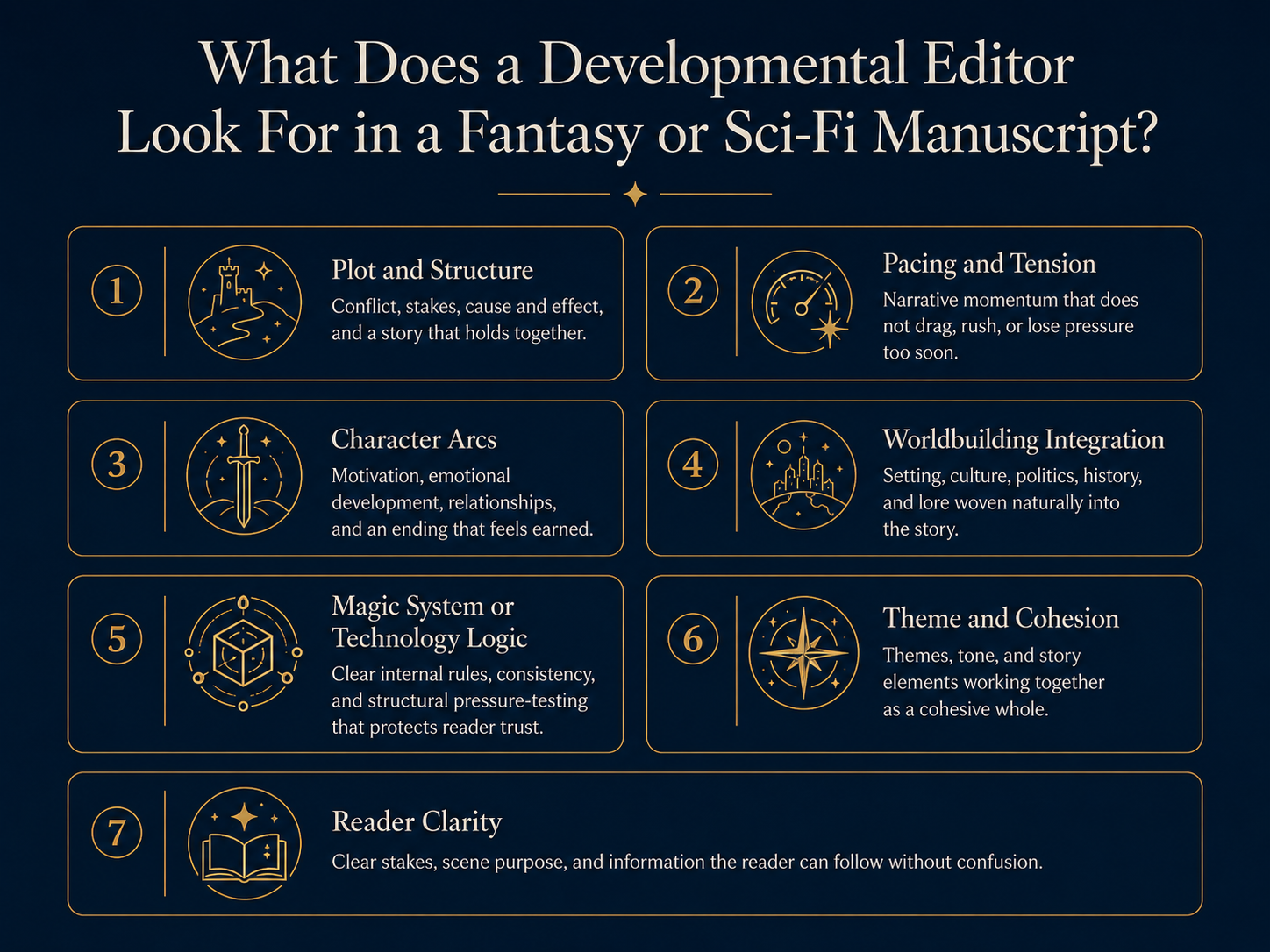
This is where you test the structural integrity of your speculative fiction novel. A developmental editor looks at the big-picture elements that determine whether the story works: plot shape, pacing, character arcs, stakes, worldbuilding logic, narrative cohesion and reader immersion.
For speculative fiction specifically, developmental editing can help you assess questions like:
Does the magic system operate consistently?
Does the worldbuilding support the plot rather than smother it?
Are the political, cultural or geographical structures believable?
Does the opening establish enough intrigue without overwhelming the reader?
Are the rules of the world clear enough for the audience to follow?
Because speculative fiction editing is so specialised, many editors have waitlists, and leaving this too late can throw off your whole publishing plan.
Developmental editing is an extremely valuable investment, helping you solve the right problems before you spend money on polishing the wrong draft. If you’re still unsure what this stage includes, read more about what a developmental editor does for fantasy or sci-fi novels.
When to book it
Start enquiring once you are in the later stages of self-editing, not after you have already decided on a launch date.
Phase III: Complete Your Developmental Revisions
Approximate time: 4–8 weeks, sometimes longer
Once you receive your editorial assessment and in-manuscript feedback, you will need time to revise and make any necessary changes.
This is the phase where your speculative fiction novel often changes the most. You may:
rewrite weak chapters
strengthen character motivations
cut or combine scenes
refine your worldbuilding logic
fix pacing issues
clarify your magic system’s logic and consequences
sharpen the book’s emotional arc
It’s best to hold off on progressing to copy-editing before your revisions are genuinely complete. A good rule of thumb is: If you are still making major structural changes, the manuscript is not ready for sentence-level editing.
Phase IV: Cover Design
Wondering where the other editing stages (copy-editing and proofreading) come in? Hold fire.
It’s best to take a detour, since cover design is one of the easiest services to misjudge. Most speculative fiction authors assume they should wait until everything else is done. In reality, you often want to schedule cover design earlier, even if the final design work happens later. Good designers can be busy months in advance, particularly if they specialise in genres like fantasy and understand the expectations of the market.
Why schedule early?
Your cover is a marketing tool, and it’s not just for decoration. For example, it tells readers whether your novel is dark fantasy, romantasy, epic fantasy, sword and sorcery, cosy fantasy… or something else entirely. That genre signalling matters.
Scheduling cover design with plenty of time gives you the opportunity to truly consider your branding and gather references and mood boards. Also, you can consider factors such as whether to align the cover direction with your release schedule and how to plan for print or eBook needs.
In many cases, the best time for the actual cover design process is when the manuscript’s structure is stable and your positioning is clear. By then, you usually have:
a settled title
a clearer understanding of the book’s tone
stronger blurb material
confidence in the final audience positioning
For speculative fiction authors writing a series, you might need more time to draft a strategic cover that is adaptable for each release.
Phase V: Copy-Editing
Approximate timeframe: 3–6 weeks
Once your developmental revisions are done and no major rewrites are pending, the manuscript is ready for prose-level editing. Depending on the service, this stage may involve:
grammar, spelling, and punctuation corrections
consistency checks
sentence clarity
tone and rhythm improvements
awkward phrasing fixes
continuity tracking for names, places, and invented terms
Speculative fiction novels often have extra continuity pressures, as you’re dealing with invented languages or terminology and lots of lore references. Because of that, the copy-editing stage is essential. A strong concept and rich world will not carry the reader if the prose feels uneven or confusing.
When to book it
Ideally, start thinking about copy-editing before your developmental revisions are fully finished.
Phase 6: Final Reviews
Approximate time: 1–2 weeks
After copy-editing, you will need time to review the changes and make final decisions. At this point, you’ll answer any editorial queries and lock in the final decisions. Once this is done, your manuscript should be treated as the final version for design and layout purposes.
Phase 7: Formatting and Typesetting
Approximate timeframe: 2–4 weeks
Formatting happens after the text is final.
This is the stage where your manuscript becomes a professional book interior for print and digital formats. Formatting can be especially important for speculative manuscripts because these books are often longer and more structurally complex. For example, you might have extra elements, such as maps and scene break graphics.
When to book
You can often book formatting in advance, but the actual work should happen only once the copy-edited manuscript is final. If the text is still changing, layout becomes inefficient and expensive to redo.
Phase 8: Proofreading
Approximate timeframe: 1–2 weeks
Proofreading is the final professional stage before publication. It takes place after formatting, not before.
In fact, proofreading is one of the most misunderstood parts of the process. Proofreading is not a lighter version of copy-editing, and it is not something you do on an unfinished manuscript. It is a final quality check on the designed file.
A proofreader looks for:
residual typos
punctuation slips
spacing issues
inconsistent styling
layout glitches
errors introduced during formatting
Because formatting can create new problems, proofreading has to be the last major review stage.
Phase 9: Launch Preparation
While your book is in the later editorial and production phases, you can begin preparing for launch at any time.
Your pre-launch checklist might look something like this:
writing your blurb
setting up retailer metadata
planning your cover reveal
building a launch team
sending ARCs
preparing social media content
updating your website or author newsletter
A common mistake is waiting until the book is fully finished before thinking about marketing. In reality, the most organised launches begin while the final stages of production are still happening.
Common Timeline Mistakes Speculative Fiction Authors Should Avoid
Booking copy-editing too early: If your story still has major structural issues, you are not ready for copy-editing yet. Fix the foundation first!
Leaving cover design until the last minute: Speculative fiction cover designers often book up early, and your cover is too important to rush.
Formatting before the text is locked: Any major text changes after formatting create extra time, cost, and confusion.
Proofreading before layout: Proofreading only works properly on the final designed files.
Underestimating revision time: Speculative fiction novels often need deeper revision passes because of worldbuilding, lore, and continuity demands. Build in breathing room.
How Far in Advance Should You Plan?
Knowing how far in advance to plan for your self-publishing journey is totally dependent on your goals. But in general, the earlier you start planning, the better.
Understanding how the end-to-end process works is crucial for making better creative decisions. After all, self-publishing works best when you treat your novel like both a creative project and a professional product.
FAQs
When should speculative fiction authors get developmental editing?
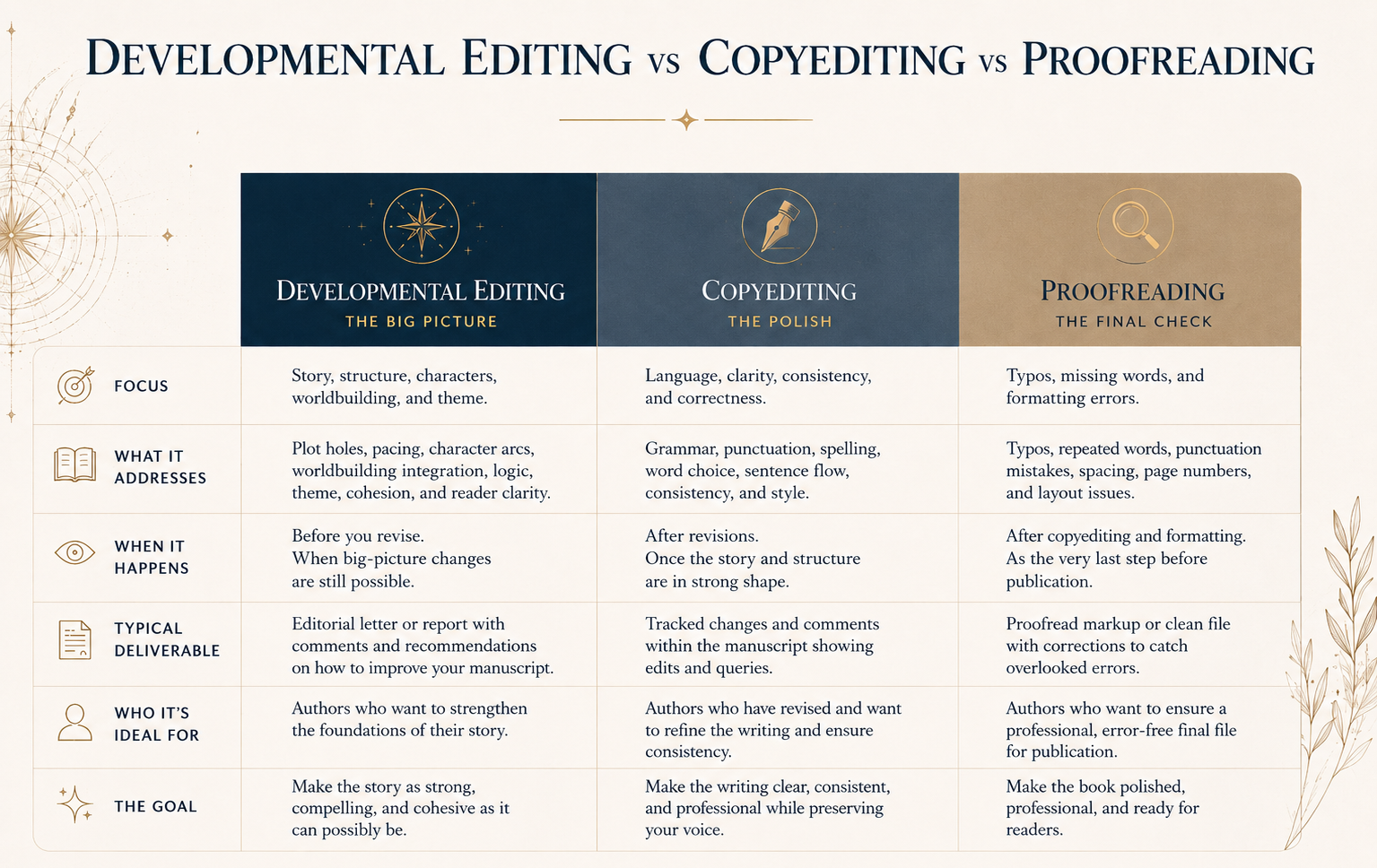
Developmental editing should happen after you finish your draft and complete a solid self-edit, but before copy-editing or proofreading.
Does developmental editing come before copy-editing?
Yes. Developmental editing focuses on structure, pacing, character arcs and worldbuilding, while copy-editing focuses on sentence-level clarity and correctness.
When should I schedule cover design for a speculative fiction novel?
It is best to start planning cover design early, even if the final design happens later, so you have time to refine your branding and market positioning.
Should formatting happen before proofreading?
Yes. Formatting comes first, and proofreading should be completed on the final formatted files.
How long does the self-publishing process take for speculative fiction authors?
It varies, but most speculative fiction authors should expect the process to take several months once the first draft is complete.
Why is a self-publishing timeline important for speculative fiction?
Speculative fiction often includes complex worldbuilding, invented systems and genre-specific reader expectations, so a clear timeline helps you avoid costly mistakes.
Can I plan later stages before my manuscript is ready?
Yes. You can plan ahead, but each stage should only begin when the manuscript is ready for it.
How can EV Editing help speculative fiction authors?
EV Editing supports speculative fiction authors with expert editorial guidance and strategic support throughout the self-publishing process.
How EV Editing Supports the Journey
A strong self-publishing timeline is about understanding what your manuscript needs at each stage, then progressing through the process in the right order. For speculative fiction authors, that structure matters even more. Complex worldbuilding, invented systems, unusual settings and genre-specific reader expectations all place extra pressure on both the manuscript and the production process. A clear timeline helps you protect the quality of your story while avoiding costly missteps later on.
At EV Editing, the goal is to help speculative fiction authors move through the publishing process with greater clarity and confidence. Whether you are refining your manuscript’s structural foundations or preparing for the later stages of production, the right guidance can make the entire journey feel far less overwhelming.
If you are ready to take the next step with your speculative fiction novel, explore EV Editing’s services or get in touch to discuss where you are in the process.