
Is Your Magic System Logical? The 3 Non-Negotiable Rules for Structural Consistency
It’s tempting to bend magic rules for the sake of your plot, thinking that readers won’t notice. But it’s the quickest way to derail reader immersion and break the contract of internal logic you’ve established with your audience.
Iron-clad magic systems are what transform speculative fiction novels from good to exceptional. In this article, I’ll outline three non-negotiable rules for creating and maintaining a structurally consistent magic system, ensuring your carefully crafted world doesn't collapse due to easy-to-miss plotholes.
This blog takes a deep dive into:
Why Inconsistent Magic Systems Are Bad For Readers
Rule 1: Define the Consequences, Not Just the Capabilities
Rule 2: Check Your Magic Interacts With Your Worldbuilding
Rule 3: Cut Out Magic System Loopholes
Tips for Stress-Testing Your Structural Integrity
Why Inconsistent Magic Systems Are Bad For Readers
In fantasy and science fiction, your readers’ trust is anchored in the mechanics of your world. When a character suddenly gains a power that wasn't previously established, or when a massive conflict is solved by a convenient, unexplained ability, your reader is left scratching their head.
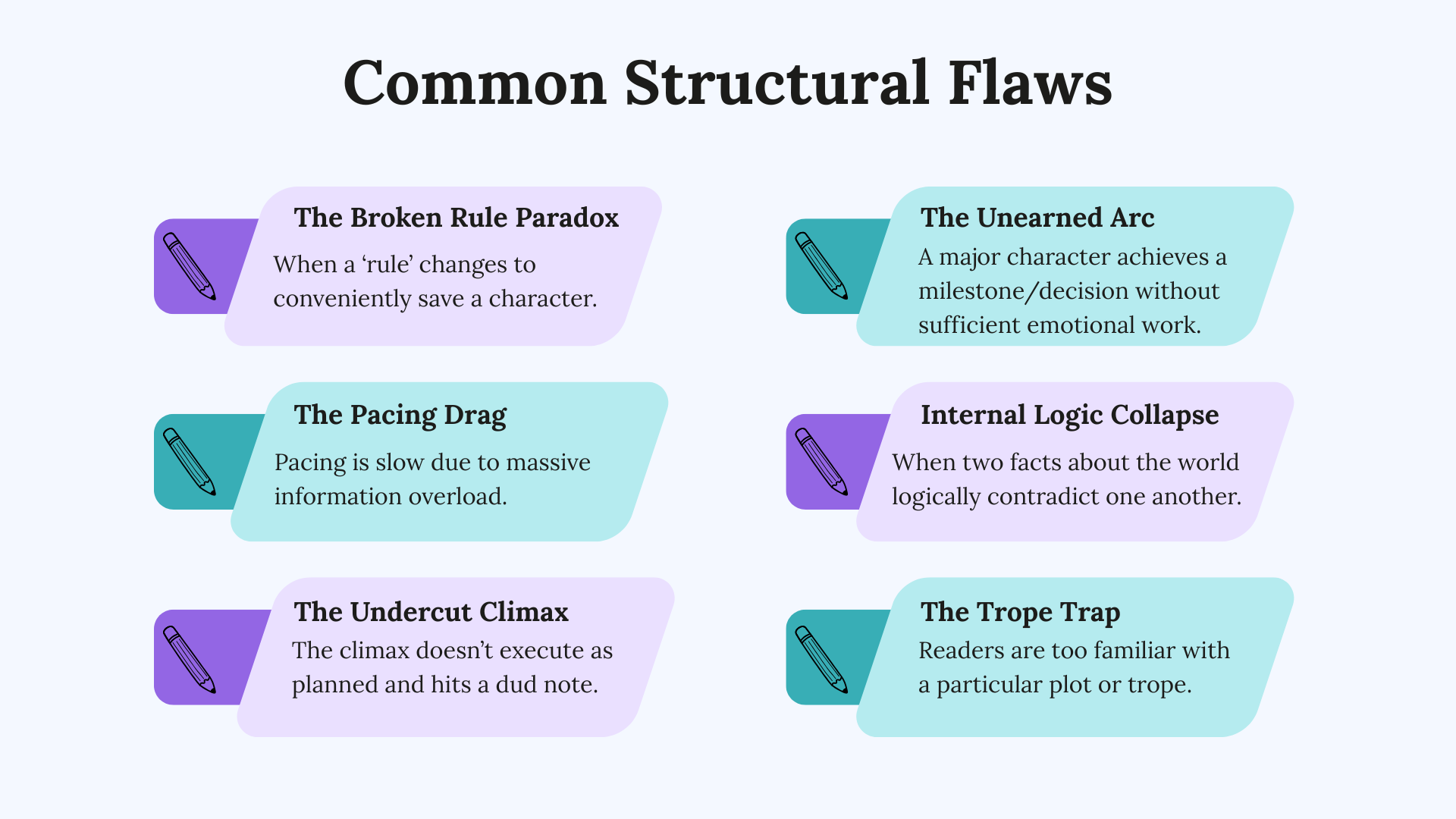
Structural flaws are a recipe for narrative friction, leading to the dreaded plot hole where logic gets abandoned altogether. A consistent magic system is what makes your story believable, establishing boundaries and providing earned conflict that feels satisfying for the reader.
Rule 1: Define the Consequences, Not Just the Capabilities
The power of your magic system is often less interesting for readers than its limitations. Yet, all magic needs a quantifiable cost, as a system where magic is limitless becomes boring and difficult to believe in.
Defining the consequences of magic comes down to:
Resource cost: Does the magic consume a physical item, such as a rare metal or a specific plant?
Physical cost: Does using the magic cause physical harm, such as fatigue or memory loss?
Moral/social cost: Does using the magic break a social taboo or require a personal sacrifice?
Extra Tip: Do the Limitation Test
The presence of a limitation forces your characters to be clever, not just uber-powerful. If your hero can solve a problem instantly and without consequence, there is no tension. When a limitation is established early on, every subsequent use of magic becomes a valuable source of much-needed tension, driving the narrative forward rather than ending it in a flop.
Rule 2: Check Your Magic Interacts With Your Worldbuilding
As we’ve explored, a consistent magic system must have a logical impact on the sociology and economy of your world. Let’s think about an example: if your magic can instantly create gold, why isn't the economy inflated? If a mage can heal any wound, why do people still die in battle, and why do hospitals still exist?
Passing the logic test is where the structural integrity of your novel will really shine. Examples of factors to consider during self-editing include:
Political implications: If magic is rare, should it create monarchies or secret guilds? If it’s common, should it be regulated by law?
Economic impact: If magic speeds up travel, does this change the trade routes or city locations in your novel?
Cultural acceptance: How does the general population view magic? Is it feared or revered?
Rule 3: Cut Out Magic System Loopholes
A magic system loophole is the moment you bend previously defined rules to get a character out of an impossible situation. Let’s be honest, it’s the structural equivalent of cheating, and the reader will always notice.
Remember that major conflicts can’t be resolved by magic unless the reader already understands what the magic is capable of. Random, brand-new solutions do nothing but cut corners and confuse readers.
Predictable and earned solutions make the reader feel smart, sure – but an obscure and pre-established solution makes them feel rewarded.
Tips for Stress-Testing Your Structural Integrity
Frustratingly, it’s possible for speculative fiction writers to be too close to your novel, meaning you might not spot the logical and structural cracks. At this point, a professional developmental editor can provide valuable guidance, which is the first tip.
For example, a developmental editor specialising in speculative fiction acts as a structural auditor for your worldbuilding. Their job is to rigorously test your magic system by asking the hard why and what-if questions, uncovering exactly how the logic does (and doesn’t) support your novel’s plot.
The second tip is fairly unusual: adopt the programmer’s mindset. You can effectively treat your magic system like code and analyse its functions in an If-Then-Else style. For example:
If [magic action] occurs, then [specific consequence] must happen.
Else [alternative, logical outcome] must occur.
It can be time-consuming to try this experiment for every major magic system in your novel, but it’s worth the effort to build defined, structural boundaries. If these If-Then-Else statements don’t work out, you’ve found a structural crack.
Consistent Magic Systems are Integral to Speculative Fiction
When you define your magic system's rules and consequences through your world, you turn your manuscript from a rough draft into a well-built final piece with consistent ‘physics.’ If you’re ever stuck, just think of these three rules: limitations (rule 1), consequences (rule 2), and adherence (rule 3).
For projects of this complexity, securing structural consistency requires an expert auditor. At EV Editing, I specialise exclusively in the structural stress test of complex narratives, ensuring your magic system is the compelling, consistent backbone of a commercially viable novel.
Book a free consultation call to discuss your manuscript’s foundation.
FAQs
Why do plot holes often appear in complex magic systems?
Plot holes in your speculative fiction manuscript’s magic systems usually stem from failing to define limitations (rule 1) or relying on magic system loopholes (rule 3). When a character gains a new ability or avoids a known cost for the sake of the plot, it breaks the established logic chain, leading to structural flaws that pull the reader out of your story.
How can a developmental editor help fix inconsistent magic system rules?
A developmental editor acts as a structural auditor, rigorously testing these three rules against your narrative. A great editor can help you implement better limitations (rule 1) and consequences that solve plot problems without sacrificing consistency.
What is structural consistency in relation to a magic system?
Structural consistency means that the internal rules of your magic system remain logical and predictable throughout the entire novel. As detailed above in rule 3, consistency is essential for maintaining reader trust and ensuring the resolution of major conflicts feels earned, not arbitrary.