

How to Manage Self-Publishing While Working Full-Time
Can you self-publish a book while working full-time? Yes, but it requires a realistic process. This guide for speculative fiction authors explains how to
manage the process realistically
avoid common mistakes
prioritise the right tasks
separate the self-publishing timeline into phases
publish professionally without carrying every moving part alone
Self-publishing while working full-time can feel like trying to run a second career in the hours you have left over. It is completely normal to feel overwhelmed, but that statement might not make you feel any better!
For many speculative fiction authors, a lack of commitment is not the issue. Rather, authors struggle to navigate the complex self-publishing journey while juggling the demands of an already busy working life.
A 2025 BookBub survey of more than 500 authors found that most authors spend between 6 and 30 hours per week writing. This statistic gives a useful sense of both how limited authors’ time can be and how many hours the dream of publication can consume.
Self-publishing works best when approached as a structured process rather than something you squeeze into evenings and weekends.
In this guide, I’ll look at how to manage self-publishing more realistically while working full-time and what to prioritise when your time is limited. Plus, I will explain how to move your book forward without burning yourself out.
Why Managing Self-Publishing While Working Full-Time Feels So Overwhelming
Many authors assume the hard part is finishing the manuscript. In reality, finishing the draft is often the point where a different kind of workload begins.
Self-publishing involves a lot of moving parts, including editing, formatting, cover design and genre positioning… to name just a few! When you are also working full-time, you might feel like you are stretching your time thinly.
For speculative fiction authors, components such as intricate worldbuilding and series planning often create an additional layer of complexity compared with a simpler manuscript. A demanding job reduces the time and mental energy available for high-quality decision-making. That is why self-publishing can start to feel chaotic even when you are deeply committed to the book.
Can You Self-Publish a Book While Working Full-Time?
For many full-time working authors, self-publishing is appealing because it offers more flexibility than the traditional route. Traditional publishing often involves long lead times and less control over components like earnings and positioning.
By contrast, self-publishing often suits writers who value creative ownership and the ability to shape the process around an already demanding career.
You can self-publish a book while working full-time, but the key is to manage the process realistically. Trying to do everything at once is usually what breaks momentum. You might find that you reach a point where you are revising Chapter Twelve, comparing cover designers, researching Amazon categories and wondering whether you need proofreading, all in the same week.
Understandably, juggling all these tasks and more can lead to more stress than progress. A better approach is to move through the publishing process in stages. Focus on the next correct decision, not every future decision at once.
Self-publishing while working full-time becomes much more sustainable when you can work in clear project phases and secure support that genuinely saves time and reduces decision fatigue.
The Biggest Self-Publishing Mistake Full-Time Working Authors Make
In my opinion, the most common mistake is trying to self-publish reactively. As an example, underestimating the time required for revisions can leave you scrabbling to meet deadlines. Leaving cover design and formatting can also leave you in the lurch, and, unfortunately, assuming weekends will be enough to carry the whole project rarely works out.
The result is often rushed decision-making that can cause costly mistakes and wasted time.
A lack of structure can trip up many authors. For example, if you copy-edit a manuscript before major structural revisions are complete, you may end up paying to polish sections that later get rewritten. Hence, it is crucial to lay out your self-publishing timeline from start to finish as soon as your draft is done.
Phases of the Self-Publishing Process You Should Know
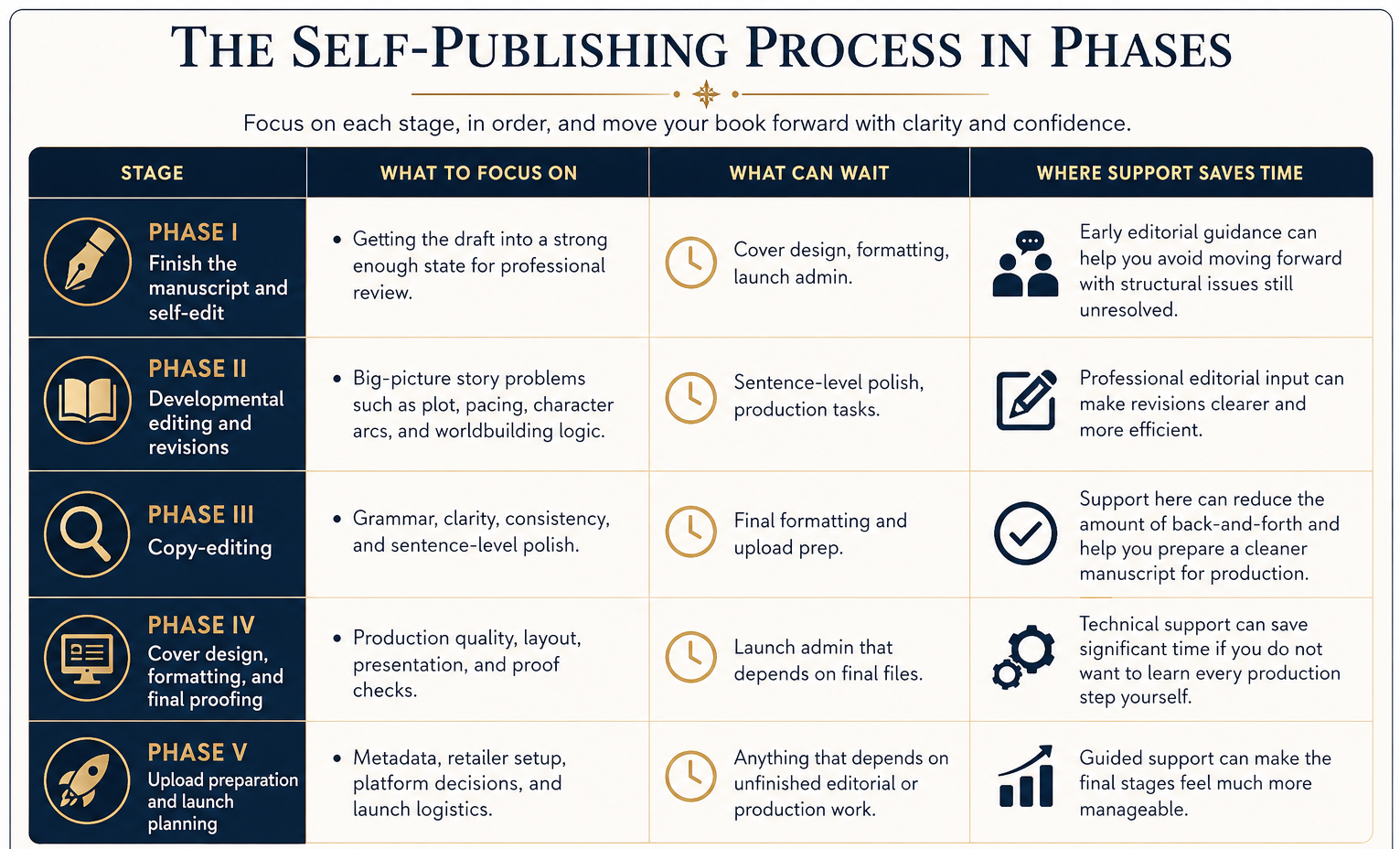
Busy authors usually cope better with self-publishing when the process is broken into phases. A practical example might look like this:
Phase I: Finish the manuscript and self-edit
Focus only on getting the draft into a strong enough state for professional review.
Phase II: Developmental editing and revisions
Solve the big-picture story problems first. For speculative fiction, developmental editing may include plot shape, pacing, character arcs, worldbuilding logic and thematic cohesion.
Phase III: Copy-editing
Only move to sentence-level polish once the manuscript is structurally stable.
Phase IV: Cover design, formatting and final proofing
These are production tasks, and this phase should happen when your manuscript is close to being locked down.
Phase V: Upload preparation and launch planning
Metadata decisions and launch admin stages are easier when you complete them after you’ve finished focusing on the editorial work.
How to Manage Self-Publishing While Working Full-Time
The good news is that self-publishing alongside a full-time job becomes much easier to manage with the right structure in place.
1. Treat the Book Like a Project, Not a Side Task
The best first step is to adopt a mindset shift and begin to see self-publishing for what it is: a complex project with various stages and deadlines.
Of course, you don’t need to become hyper-corporate about your novel. This stage is about acknowledging that the book will move more smoothly if you give it a framework, and developing such a framework is worth every minute of prep.
Put pen to paper and develop a simple self-publishing plan that should answer:
what stage the manuscript is in now
what the next stage is
what has to happen before that next stage can begin
what decisions can wait
where outside support may be needed
2. Work in Phases Instead of Trying to Do Everything at Once
I outlined the phases above, but this approach is so important that I will cover them again. Here is an at-a-glance system you can follow.
3. Decide What Actually Needs Your Attention
Not every task needs your attention at the same level, as some are high-value and highly specific to your personal opinions and capabilities. Some parts of self-publishing are high-value and highly personal, which means they benefit most from your direct involvement. Example tasks that may need your input include self-editing your manuscript and approving the cover direction.
Other tasks may still need some oversight from you, but not your constant hands-on management. A structured publishing process matters even more in a crowded market: Bowker data reported by Publishers Weekly showed self-published print and ebook titles with ISBNs rising 38.7% last year.
In today’s environment, publishing professionally is about making sure the right tasks get high-quality execution at the right stage. For busy authors, this is where structured publication management can make a real difference.
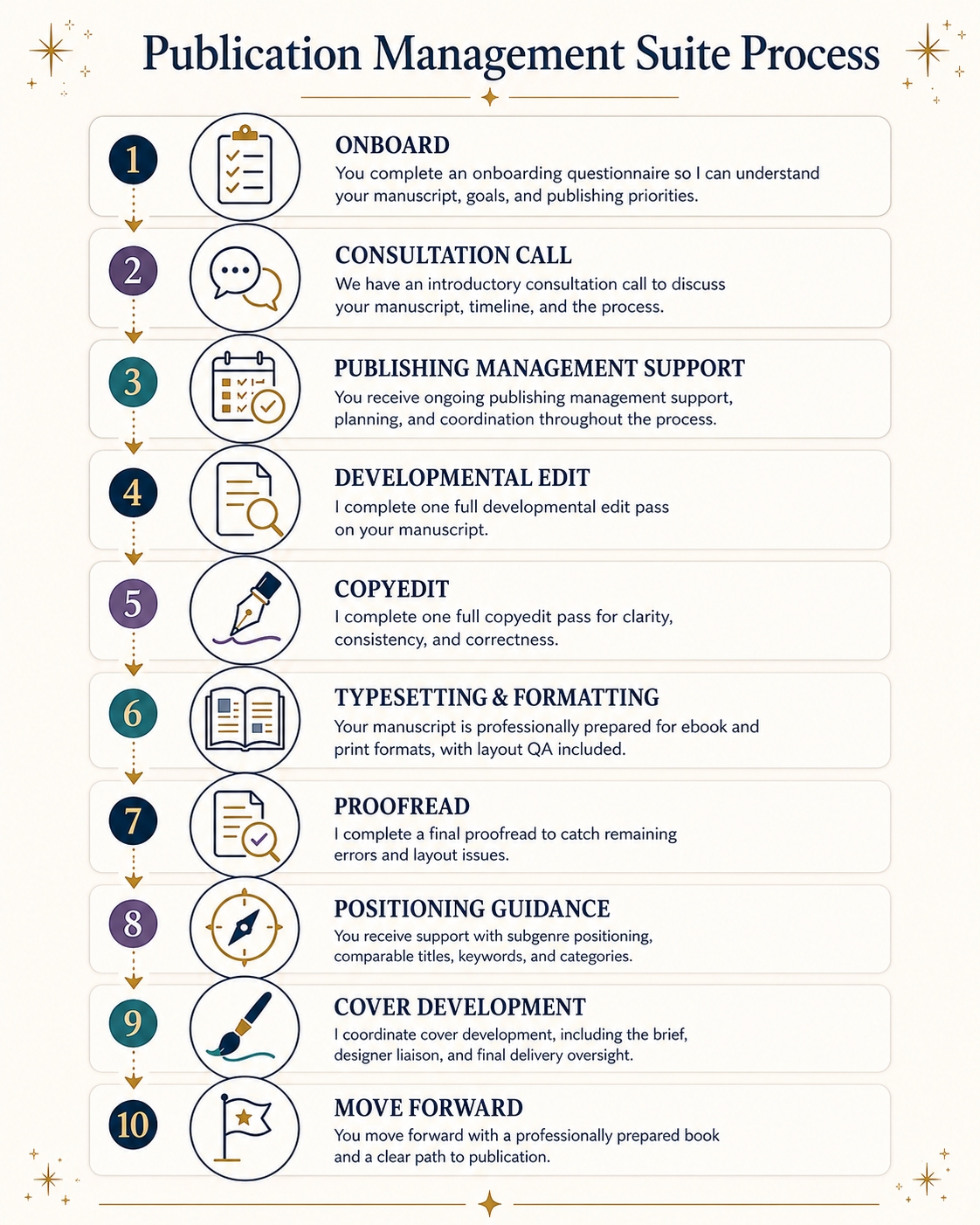
EV Editing’s Publication Management Suite is designed to support authors through an end-to-end publishing timeline by coordinating your project across every stage. You stay creatively involved without having to personally manage every moving part alone.
4. Build Buffer Time Into Every Stage
A demanding week at work can wipe out your evening writing time, and life commitments can easily consume the weekend you thought you would dedicate to publishing tasks.
Setting an overly ambitious timeline is risky and can lead to rushed decisions and unnecessary stress. Ultimately, I believe a calmer timeline produces a better book.
A good rule of thumb is that, if you think revisions will take four weeks, give yourself six. Planning to get your book live in seven months? Give yourself nine.
5. Be Realistic About the Time Cost of Learning New Tasks
One of the easiest ways to underestimate self-publishing is to focus only on whether a task is possible to do yourself, rather than on how long it will take to learn properly.
In practice, learning a new task from scratch can absorb far more time than authors expect.
I believe that typesetting is a good example. A misconception is that typesetting is simply a matter of making the book look tidy, when the reality is that you may need to learn about front and back matter, ebook and print formatting differences, layout conventions, file checks, and the kinds of issues that only become obvious once you are working with final proofs. It is, truly, an exhaustive list of to-dos.
That time may be worth investing if you genuinely want to build that skill. But if you are already balancing a full-time job, it is worth asking whether your limited time is better spent there, or on the parts of the process that most need your judgement and creative attention.
Delegating responsibilities like typesetting to a professional self-publishing consultancy especially valuable for busy speculative fiction authors who want to stay creatively involved without having to learn every technical stage from scratch.
6. Separate Creative Energy From Admin Energy
Creative editing and writing are fun, requiring an enjoyable type of focus and reward that you won’t get from administration tasks like preparing your manuscript for upload.
When you try to do both in the same working session, you might end up doing neither particularly well. This tip is even more relevant if your day job already demands concentration and you need to save your best creative energy.
My personal preference is to use higher-energy sessions for revisions and story work, and lower-energy or time-sensitive sessions for project coordination and administration.
7. Get Professional Support Before You Hit Burnout
Many authors wait until they are already overwhelmed before asking for help. Usually, the earlier you seek professional support, the more cohesive and straightforward the self-publishing journey will be.
Professional support exists to help you reduce decision fatigue and move through the process in the right order, without sacrificing the time and energy you would likely rather dedicate to your full-time job.
Support from a self-publishing consultancy like EV Editing is most relevant for authors who are taking the self-pub route for the first time or have limited availability outside work. Delegating the process to a professional is the right choice if you lack the bandwidth to coordinate every stage alone but still want a high-quality final novel.
How EV Editing Supports Busy Speculative Fiction Authors
A lot of authors quietly assume that choosing self-publishing means they should be able to manage every moving part themselves. Yet self-publishing is a complex and lengthy process. The reality is that you will likely find yourself juggling high-pressure deadlines, decision-making, brand-new skills and uncertainty whilst balancing your full-time employment. Effectively, you need to become a one-person publishing department.
EV Editing exists to support speculative fiction authors seeking professional publication without carrying the entire process alone. If you are managing self-publishing alongside a full-time job, the right support can make the process feel clearer, far more achievable, and more enjoyable.
Whether you are seeking developmental editing services or consistent editorial direction across copy-editing and proofreading, EV Editing can provide expert input. And for authors who want expert guidance across the full journey, the Publication Management Suite offers structured support from manuscript to publication without taking creative control out of your hands.
If you are balancing self-publishing with a full-time job and want the process to feel more manageable, view EV Editing’s services or get in touch to discuss how best to support your book.
FAQs About Managing Self-Publishing While Working Full-Time
Is it realistic to self-publish a novel while working full-time?
Yes. Many authors do. The key is to plan a realistic timeline and break the process down into stages. For busy authors, the right professional support can also make self-publishing much more manageable alongside a full-time job.
How long does self-publishing take if you work full-time?
It depends on the manuscript stage and the amount of revisions needed. Plus, don’t forget that you may find yourself learning time-consuming new skills, such as typesetting. In practice, full-time working authors usually benefit from longer timelines and more buffer space than they first expect.
Booking self-publishing management can speed up this process, which is why it’s sometimes a good idea to leave it to the pros!
Do I need to learn every skill involved in self-publishing?
No. While it is possible to learn many parts of self-publishing, doing so can take a significant amount of time and energy. If you are already managing a full-time job, it is often more effective to focus on the decisions that need your creative input and seek support with the more technical stages.
Is self-publishing harder than writing the book?
For many authors, it can feel that way. Writing is only one part of the process. Self-publishing also involves planning, coordination, decision-making and professional execution.